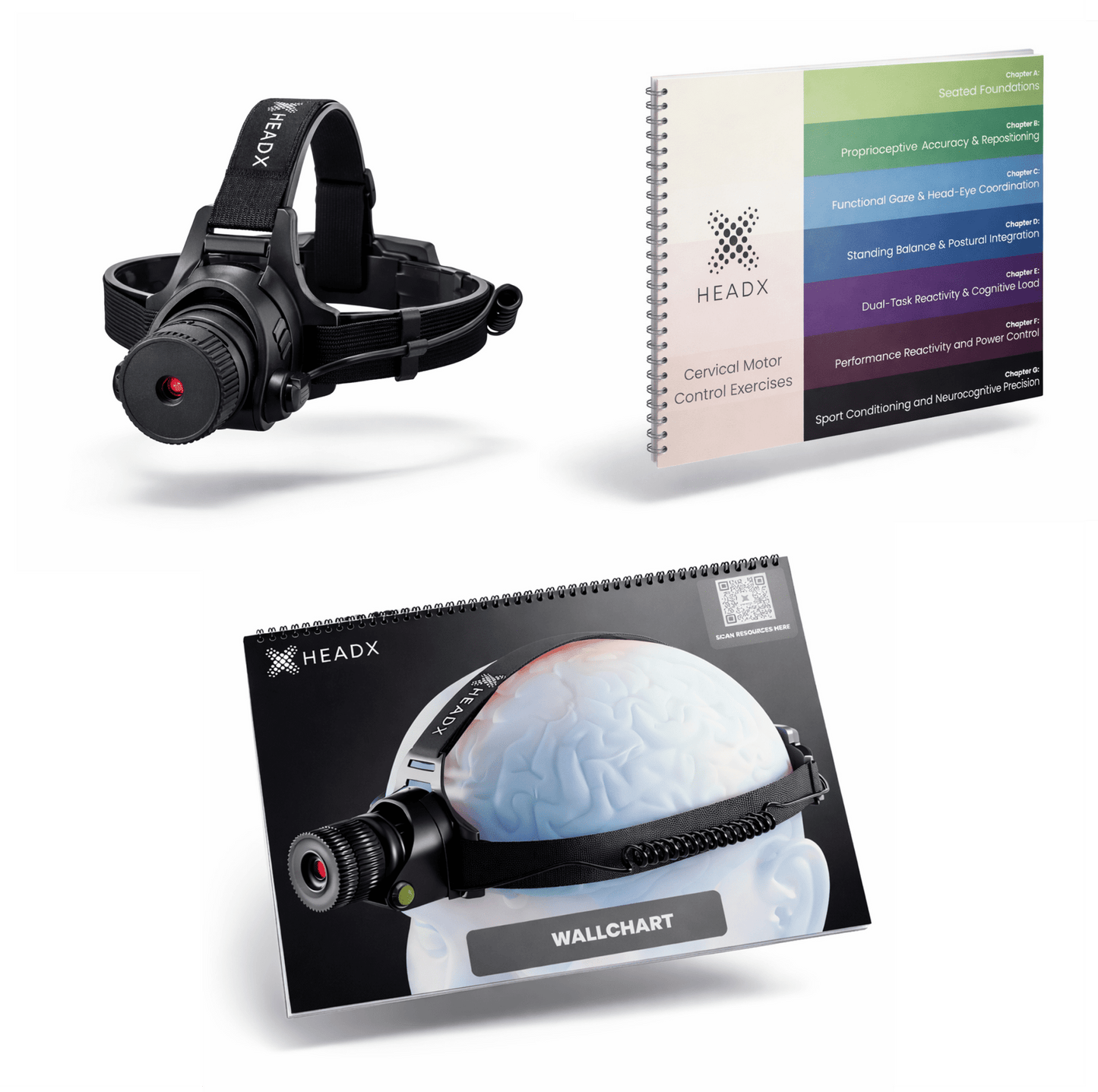
kross_soft_product_image

HeadX Kross

Patented Crosshair Laser

HeadX Kross provides precise crosshair laser feedback to support targeted head and neck control exercises, helping users improve movement accuracy, proprioception, and repeatable rehabilitation practice over time.

Want to see more? Book a 15 minute demo

Why Patients and Clinicians Trust HeadX

  • headx_images_55

    Instant Feedback

    Immediate crosshair-laser feedback lets the person and clinician observe target error and unwanted tilt during the selected task.

  • ChatGPT_Image_May_12_2026_09_29_49_PM_5

    Three-Plane Visual Feedback

    The crosshair makes head position and orientation visible across pitch, yaw and roll. Kross provides visual feedback rather than recording digital movement data.

  • headx_images_36

    Clinician Designed

    Clinician-led design supports practical fitting and consistent exercise delivery in clinic or, after appropriate instruction, at home.

Purchase

Passa alle informazioni sul prodotto

HeadX Kross

HeadX Kross

Cross Hair Laser

Prezzo di listino £160.00
Prezzo scontato £160.00
Prezzo di listino Save Esaurito
Visualizza dettagli completi
Selected Variant Image
HeadX Kross
Kross Only
Prezzo di listino £160.00
Prezzo di listino Prezzo scontato £160.00
Selected Variant Image
HeadX Kross
Kross Only
Prezzo di listino £160.00
Prezzo di listino Prezzo scontato £160.00

FAQ

What does the HeadX Kross measure?

HeadX Kross projects a crosshair laser onto a wall-mounted target, making head position and orientation visible across pitch, yaw and roll. It does not record digital movement data. A clinician can use a consistent target-and-distance protocol to observe movement quality and manually calculate head-repositioning error.

What is Joint Position Error testing and how does the HeadX Kross support it?

Joint Position Error testing assesses how closely a person returns the head to a reference position after active movement. Kross projects a crosshair onto a target so displacement can be read in centimetres and converted to angular error using the test distance. A mean error of approximately 4.5° has historically been used as a reference in some protocols, but it is not a universal diagnostic, recovery or discharge threshold.

In which clinical settings might HeadX Kross be used?

A suitably qualified clinician may select Kross when cervical movement, head-repositioning, gaze-control, balance or head-control tasks are relevant to an assessment or rehabilitation plan. Kross does not diagnose concussion, vestibular disorders, neck pain or neurological conditions.

How does the HeadX Kross differ from a CROM device or goniometer?

CROM devices and goniometers are used to quantify cervical range of motion. Kross provides crosshair-laser feedback for head-repositioning and exercise tasks; any displacement or angular error is read and recorded manually. HeadX Duo adds app-connected digital movement recording.

What planes of movement does the HeadX Kross assess?

The HeadX Kross provides feedback across all three rotational planes: pitch (nodding — flexion and extension), yaw (turning — left and right rotation), and roll (tilting — lateral flexion). Research indicates it is most appropriate for assessment in the sagittal and transverse planes; the coronal plane requires additional consideration in clinical interpretation.

Can the HeadX Kross be used for home-based rehabilitation?

Yes, after appropriate fitting and instruction. A clinician should confirm that home use is suitable and select the exercise, dose and progression. The HeadX exercise library provides a graduated framework rather than an individual treatment prescription.

What laser class is the HeadX Kross?

HeadX Kross uses a Class 1 laser. Use it according to the supplied instructions, do not deliberately stare into the beam, and check the product guidance if you have any safety questions.